

How to Rank in ChatGPT Search Results: To rank in ChatGPT search results, focus on creating accurate, experience-driven, and well-structured content that answers users’ questions better than competitors. Build topical authority, improve your website’s technical SEO, earn high-quality backlinks, use structured data, and optimize your content for AI search engines, not just traditional Google rankings.
Search is changing faster than ever. While Google remains a dominant search engine, millions of users now ask questions directly to AI assistants like ChatGPT before visiting websites. Instead of scrolling through dozens of blue links, users expect instant, accurate, and trustworthy answers.
This shift has introduced a new approach to search optimization. Ranking on Google is no longer enough; you also need your website to become a trusted source for AI-powered search experiences.
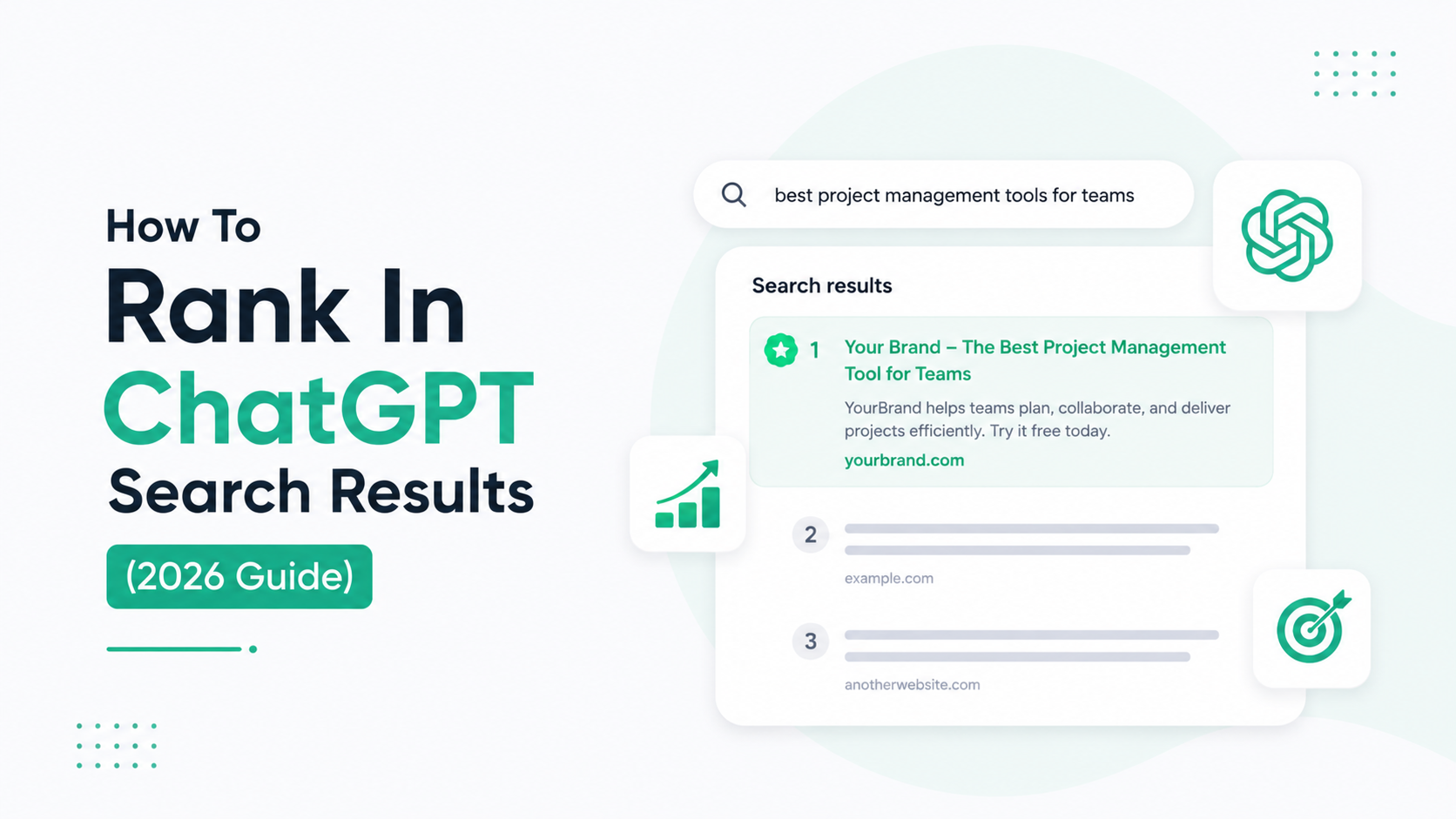
ChatGPT doesn’t rank websites exactly the way traditional search engines do. Instead, it prioritizes reliable information, authoritative sources, structured content, and pages that clearly answer user intent. Businesses that adapt to AI SEO today will have a significant advantage over competitors in the coming years.
In this comprehensive guide, you’ll learn how ChatGPT selects information, the factors that influence visibility, and practical strategies you can implement to improve your chances of appearing in AI-generated answers.
What is ChatGPT Search?
ChatGPT Search is an AI-powered search experience that combines conversational responses with information gathered from trusted online sources. Instead of displaying a list of websites, it provides summarized answers while referencing authoritative content whenever appropriate.
Unlike traditional search engines, ChatGPT aims to solve the user’s problem directly by understanding intent rather than matching keywords alone.
Why Ranking in ChatGPT Matters
AI-powered search is becoming one of the fastest-growing ways people discover information.
Benefits include:
- Increased brand visibility
- Higher authority in your industry
- Better qualified website traffic
- Improved trust among potential customers
- Greater chances of being cited by AI assistants
- Long-term organic growth
As more businesses adopt AI optimization, early adopters will build stronger digital authority.
How ChatGPT Chooses Content
Although the exact algorithms are proprietary and continue to evolve, AI systems generally evaluate content based on several important signals.
1. Content Quality
Your content should:
- Solve real problems
- Be factually accurate
- Include examples
- Cover topics comprehensively
- Stay updated regularly
Thin or repetitive content is much less likely to be useful for AI-generated answers.
2. Topical Authority
Publishing one article is rarely enough.
Instead, build an entire content ecosystem around your niche.
For example, if your website focuses on SEO, publish related content covering:
- Technical SEO
- On-page SEO
- Local SEO
- AI SEO
- Link building
- EEAT
- Core Web Vitals
- Schema markup
- Keyword research
- SEO audits
The deeper your expertise, the stronger your authority.
3. EEAT Signals
Google introduced EEAT, and these principles are also valuable for AI search.
EEAT stands for:
- Experience
- Expertise
- Authoritativeness
- Trustworthiness
Improve EEAT by:
- Showing author information
- Including credentials
- Adding company details
- Publishing original research
- Using real examples
- Keeping content updated
- Citing trustworthy sources where appropriate
4. Answer User Intent
AI prioritizes pages that directly answer user questions.
Instead of writing only around keywords, think about the questions users actually ask.
Example:
Instead of:
“SEO Services”
Create:
- What are SEO services?
- How much do SEO services cost?
- Is SEO worth it in 2026?
- How long does SEO take?
Optimize for Questions
People interact with ChatGPT using natural language.
Include questions throughout your content such as:
- What is AI SEO?
- Why is AI search important?
- How does ChatGPT search work?
- What are the benefits?
- Which businesses should optimize for AI?
This increases the likelihood that your content aligns with conversational queries.
Write Comprehensive Content

AI prefers complete resources.
A high-quality article should include:
- Definitions
- Benefits
- Step-by-step guides
- Real-world examples
- Statistics (when verified)
- Best practices
- Common mistakes
- Expert tips
- FAQs
- Conclusion
Aim to fully satisfy the user’s query in one place.
Structure Content Clearly
Use:
- One H1
- Logical H2 and H3 headings
- Bullet lists
- Tables
- Short paragraphs
- Numbered steps
- Summary boxes
- FAQs
Well-structured content is easier for both users and AI systems to interpret.
Improve Technical SEO
Technical optimization still matters.
Checklist:
- Fast loading speed
- Mobile-friendly design
- HTTPS security
- XML sitemap
- Robots.txt
- Canonical tags
- Clean URLs
- Internal linking
- Image optimization
- Core Web Vitals optimization
A technically sound website provides a better user experience and supports discoverability.
Use Structured Data
Schema markup helps search engines understand your content.
Important schema types include:
- Organization
- Article
- FAQ
- Breadcrumb
- Person
- Local Business
- Service
- Review
- Product (if applicable)
- WebPage
Structured data improves context and can enhance visibility across search experiences.
Build High-Quality Backlinks
Backlinks remain a strong trust signal.
Focus on earning links through:
- Original research
- Industry studies
- Guest blogging
- Digital PR
- Case studies
- Helpful resources
- Expert interviews
Quality matters far more than quantity.
Publish Original Content
Avoid copying or lightly rewriting existing articles.
Instead, include:
- Personal experience
- Industry insights
- Real client examples
- Original graphics
- Custom illustrations
- Proprietary data
- Unique frameworks
Originality helps establish credibility.
Keep Content Fresh
Update articles regularly.
Refresh:
- Statistics
- Screenshots
- Examples
- Pricing
- Trends
- Tools
- Best practices
Fresh content is more likely to remain relevant.
Improve User Experience
Good UX contributes to trust and engagement.
Focus on:
- Easy navigation
- Readable typography
- Clear CTAs
- Responsive design
- Accessible layouts
- Minimal distractions
When users find information quickly, they’re more likely to stay engaged.
Create Supporting Content Clusters
Don’t rely on a single article.
Build interconnected resources around AI SEO.
Examples:
- What is AI SEO?
- GEO vs SEO
- AEO Explained
- AI Search Optimization Checklist
- Best AI SEO Tools
- ChatGPT vs Google Search
- How AI Changes Keyword Research
- AI Content Best Practices
Interlink these articles to strengthen topical authority.
Common Mistakes to Avoid
Many websites struggle because they:
- Focus only on keywords
- Publish thin articles
- Ignore EEAT
- Skip schema markup
- Have poor internal linking
- Use outdated information
- Ignore user intent
- Publish AI-generated content without editing
- Neglect technical SEO
- Fail to build authority
Avoiding these mistakes can significantly improve content quality.
Future of AI Search
AI-powered search will continue evolving.
Successful websites will focus less on ranking for isolated keywords and more on becoming trusted knowledge sources.
The future belongs to websites that:
- Educate users
- Demonstrate expertise
- Provide original value
- Answer questions comprehensively
- Continuously update content
Businesses that invest in AI SEO today will be better positioned for tomorrow’s search landscape.
Ranking in ChatGPT search results isn’t about gaming an algorithm, it’s about becoming a trusted, authoritative source that genuinely helps users. By creating high-quality, well-structured, and experience-driven content, strengthening your technical SEO, building topical authority, and keeping information up to date, you increase the likelihood that AI systems will recognize your website as a valuable resource.
Think beyond traditional keyword rankings. Focus on answering real questions, demonstrating expertise, and delivering exceptional user value. As AI-powered search continues to evolve, websites that prioritize trust, accuracy, and usefulness will be the ones that stand out.
Frequently Asked Questions (FAQs)
1. Can my website rank in ChatGPT search results?
Yes. Websites that publish accurate, authoritative, and well-structured content have a better chance of being surfaced or cited in AI-powered search experiences.
2. Is ChatGPT SEO different from Google SEO?
There is significant overlap, but ChatGPT places even greater emphasis on helpful, conversational, trustworthy, and comprehensive content that directly answers user intent.
3. What is the most important factor for AI SEO?
There is no single ranking factor. High-quality content, topical authority, EEAT, technical SEO, structured data, and strong user experience all work together.
4. Does schema markup help with AI search?
Yes. Structured data provides additional context about your content, making it easier for search engines and AI systems to understand your pages.
5. Are backlinks still important for AI SEO?
Yes. High-quality backlinks remain a strong indicator of trust and authority, which can indirectly improve your visibility in AI-powered search.
6. How often should I update my content?
Review important articles every 3–6 months or whenever there are significant industry changes, new tools, or updated best practices.
7. Can AI-generated content rank?
It can, but only if it is accurate, original, thoroughly reviewed, and genuinely helpful. Publishing unedited or low-quality AI-generated content is unlikely to perform well.
8. What is the difference between SEO, AEO, and GEO?
SEO focuses on improving visibility in traditional search engines, AEO (Answer Engine Optimization) targets answer-based platforms, and GEO (Generative Engine Optimization) aims to optimize content for AI-powered search experiences like ChatGPT and other generative search tools.

 INDIA
INDIA INDIA
INDIA
Leave a Reply